Law firm website: maintenance, audit or redesign?
A law firm's website does not always need a redesign. Choose between maintenance, an audit, targeted fixes or a redesign based on its actual condition.
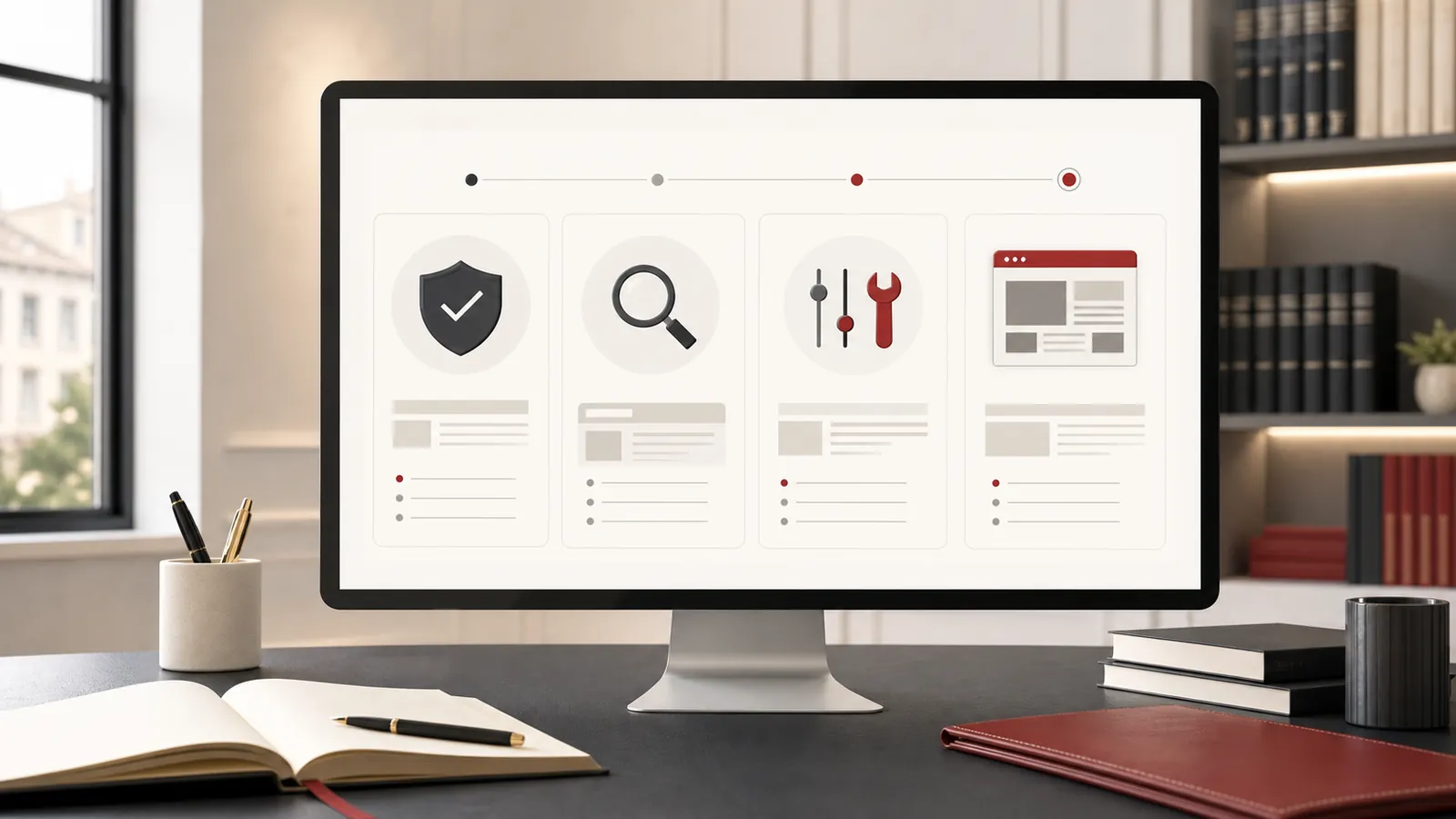
When a law firm doubts its site, the first idea is often to do it again. The design appears dated, the pages no longer reflect the expertise, the form is not very visible or the site seems less credible than that of other firms.
Sometimes a redesign is actually needed. But not always.
A law firm's website may simply need serious maintenance. It may also require an audit before any decision is taken. It can sometimes be improved with some targeted corrections: form, expert pages, mobile performance, menu structure, titles, content or technical follow-up.
Before deciding a redesign, choose the level of action that corresponds to the actual state of the site.
For a firm, this decision counts. The site reassures a prospect, presents areas of intervention, gives contact information, receives requests, supports local SEO and gives a signal of seriousness.
Useful decision
Maintenance, audit, corrections or redesign: the choice depends on the actual status of the site.
An older website can remain sound; a recent one can already have problems. The aim is to choose the right level of work rather than automatically sell the largest project.
The bad reflex: decide from the age of the site
An ancient site is not necessarily a bad site. A recent site is not necessarily a good site.
A five-year site can still be solid if it is clear, maintained, fast, easy to modify, well structured and consistent with the firm. Conversely, a recent site may already be problematic if it is based on a confused structure, a heavy theme, weak pages or a lack of follow-up.
The age of the site gives an indication, but it must not be the only criterion. The issues to be addressed are more concrete:
- Does the site still reflect the firm's expertise?
- Are important pages easy to find?
- Does the form really work?
- Are contact details visible?
- Is the site readable on mobile?
- Are the content up to date?
- Is the existing SEO identified?
- Are access details, backups and updates controlled?
- Can the site be improved without doing everything again?
A redesign decided too quickly can cost money and cause useful signals to be lost. Maintenance applied on a too low basis can also be a poor economy. So we have to choose in the right order.
When maintenance is enough
Maintenance is sufficient when the site is generally healthy.
This is the case if the structure remains clear, if the main pages are useful, if the firm can still modify the content, if the form works, if the hosting is correct and if the main problem is the lack of follow-up.
In this situation, the firm does not necessarily need a redesign. It mainly needs someone to keep the existing website under control:
- WordPress updates;
- verified backups;
- Basic security;
- form tested;
- small corrections;
- monitoring of access;
- monitoring important pages;
- clear support when an application appears.
For a law firm, the site maintenance Above all, it protects continuity. An associate arrives, an address changes, an expert page needs to be adjusted, a statement needs to be corrected, a form needs to be checked, a plugin needs to be updated. These subjects should not be blocked for weeks.
Article Maintenance law firm's website: what a firm really needs to monitor details these points. Maintenance is relevant when the site deserves to be conserved and simply better monitored.
When an audit becomes the right first step
An audit becomes useful when the firm no longer really knows the state of its site.
The site may be working, but it's slow. The pages seem confused. The access details are scattered. The backups are not clear. The historical service provider does not document the follow-up. Mobile performance is poor. SEO stagnates. The form is not tested. The content has been added over the years without solid structure.
In this case, directly choosing maintenance or redesign may be premature.
The audit is used to answer simple questions:
- What's still working?
- What weakens the site?
- Which pages should be kept?
- What content should be corrected or merged?
- What URLs have an SEO value?
- Does the problem come from technique, content, structure or monitoring?
- Is maintenance enough?
- Is a redesign really justified?
A useful audit should help you make a decision, rather than impress you. That is the role of our page on site audit WordPress and SEO and Article When do you really need a WordPress website audit?.
For a firm, audit is often the right first step when the decision is not obvious.
When targeted corrections may be sufficient
Between maintenance and full redesign, there is often a more rational option: correcting the points that really block.
A law firm's website can be globally correct but lose efficiency due to visible details:
- contact button too discreet;
- form too long or poorly configured;
- too vague home page;
- weak pages of expertise;
- menu poorly prioritized;
- contact details that are hard to find;
- slow site on mobile;
- Titles of unclear pages;
- dated contents;
- lack of links between important pages.
A complete rebuild may be unnecessary. Improving the homepage, strengthening expertise pages, clarifying contact options, speeding up the website or fixing the form may be enough.
This approach is interesting when the technical basis remains sound and the firm wants to quickly improve the credibility of the site without immediately engaging a heavy redesign.
It still requires a method. Avoid piling up random fixes. Identify what actually hinders understanding, trust or contact.
When the redesign becomes rational
The redesign becomes more logical when the site can no longer be improved properly.
This is the case if the structure is too weak, if the contents are dispersed, if the theme is heavy or abandoned, if the important pages are poorly constructed, if the site no longer reflects the position of the firm, or if each simple modification becomes complicated.
For a law firm, a redesign may become necessary when:
- the main expertise is not visible;
- the site no longer reassures prospects;
- the design gives a dated or neglected impression;
- pages do not help Google understand the firm;
- existing URLs need to be handled properly;
- the site is technically difficult to maintain;
- the form or contact is poorly integrated;
- the existing one prevents you from adding useful pages.
A serious redesign is not just about changing the appearance. It must process structure, content, technique, redirections, existing SEO and maintenance after posting.
Article How much does a law firm website redesign cost? explains why the budget depends less on the number of pages than the actual status of the site, recoverable content, SEO issues and the method of recovery.
Specific points for a law firm
A law firm's website is not a brochure website like any other. It must remain sober, clear, credible and verifiable.
Visitors often seek reassurance before contacting the firm. They want to understand the areas of intervention, the perceived experience, the location, the modalities of contact and the seriousness of the structure.
A few points are of particular importance:
- clear pages of expertise;
- visible contact details;
- reliable form;
- up-to-date law firm information;
- a restrained tone;
- simple navigation;
- correct mobile performance;
- lack of excessive commercial promise;
- contents read by the firm;
- Regular maintenance.
The form deserves special attention. A site may seem correct, but no longer transmit requests. For a firm, this technical detail can become a loss of contact. Article WordPress form no longer works deals with this subject more broadly.
Access details and backups also matter. If the firm does not know who manages the domain, where the backups are or who can fix an urgent page, maintenance becomes more than a technical update. It becomes a framework of responsibility.
SEO: Do not lose what already works
A firm considering a redesign must pay attention to its existing SEO.
Although traffic appears to be low, some pages may already receive impressions, emerge from local queries or carry useful signals. Removing these pages, changing URLs or rewriting without analysis can push the site back.
Before a redesign, you have to look at:
- indexed pages;
- Search Console queries;
- pages that receive impressions;
- the old important URLs;
- content that deserves to be kept;
- the pages to be merged;
- the necessary redirections;
- titles and descriptions of key pages;
- local pages and pages of expertise.
Article Redesigning your law firm's website without losing search visibility details this point. A redesign can improve visibility, but only if it preserves or improves what was already valuable.
If the main topic is the local SEO, the article Local SEO for law firms: improving visibility on Google complete this reading.
Legal content and professional constraints: who validates what?
2Cafés can help structure a law firm's website, clarify pages, improve readability, make the contact path simpler and deal with technical issues. But legal content and communication choices must remain validated by the firm.
It's an important limit.
A web service provider can check page consistency, readability, internal linking, titles, contact calls, performance and technical structure. It can point points to be read again, propose a clearer organization and avoid an overly aggressive tone.
It does not replace the lawyer, bar association or legal advice on applicable professional rules. The firm must approve practice areas, sensitive wording, professional references and communication choices.
Work collaboratively: the provider handles structure and technical implementation; the firm validates the professional content.
Simple matrix to decide
Maintenance
Choose whether the site is healthy, still credible, technically stable and especially poorly monitored. Purpose: to keep the site under control.
Audit
Choose whether the site is unclear, whether the firm hesitates, whether the site is slow, unstable, confused or difficult to resume. Objective: to decide before investing.
Targeted fixes
To choose whether the base is correct but that certain visible points hinder confidence or contact. Objective: to improve without repeating everything.
Redesign
To choose whether the structure, content, technique or image of the site no longer adequately support the firm. Objective: to take over the base properly.
If you don't know what box your site is in, start with a no-obligation diagnostic review. The first objective is to determine whether the site deserves maintenance, an audit, some corrections or a redesign.
Key takeaway
A law firm's website should not be redone simply because it looks old. It must be assessed on the basis of its real role: reassure, explain the expertise, facilitate contact, remain reliable, support visibility and maintain a serious image.
Maintenance is enough if the base is healthy. The audit becomes useful if the situation is unclear. Targeted corrections may be sufficient if a few points block conversion. The redesign becomes rational if the site can no longer carry the firm properly.
The right choice corresponds to the real state of the site.
If your firm hesitates between maintenance, audit or redesign, send the site URL via the diagnostic review. You will leave with a first reading: what can be kept, what needs to be corrected, and what should not be changed too quickly.
Frequently asked questions
When is maintenance sufficient for a law firm's website?
Maintenance is sufficient if the site is sound, legible, technically stable and still consistent with the firm. It allows you to keep updates, backups, form, access details and small corrections under control.
When do you need to audit a law firm's website?
An audit becomes useful if the site is slow, confusing, difficult to modify, technically unclear, or if the firm hesitates between maintenance, corrections and redesign. It is used to decide before investing in the wrong solution.
When does a law firm's website redesign become necessary?
A redesign becomes rational if the site no longer reflects the expertise of the firm, if the important pages are weak, if the contact is misthought, or if the technical basis prevents the actual improvement.
Do you need a new law firm's website to improve your SEO?
Not always. The first step is to analyze existing pages, queries, useful content and already indexed URLs. A redesign without analysis can cause useful signals to be lost.
Who validates the legal content of the site?
The firm must validate business content, areas of intervention, professional indications and sensitive formulations. 2Cafés can help structure, clarify and integrate these contents into a more readable site, but does not replace firm validation.
Does 2Cafés guarantee the ethical compliance of the site?
No. 2Cafés does not replace the firm, its bar association or legal adviser. Support covers structure, technical work, readability and website checks. The firm must approve legal content and professional ethics decisions.
Read next.

Law firm website maintenance: what a firm really needs to monitor
Security, backups, forms, updates and key pages: what to monitor when maintaining a law firm's website.
Read the article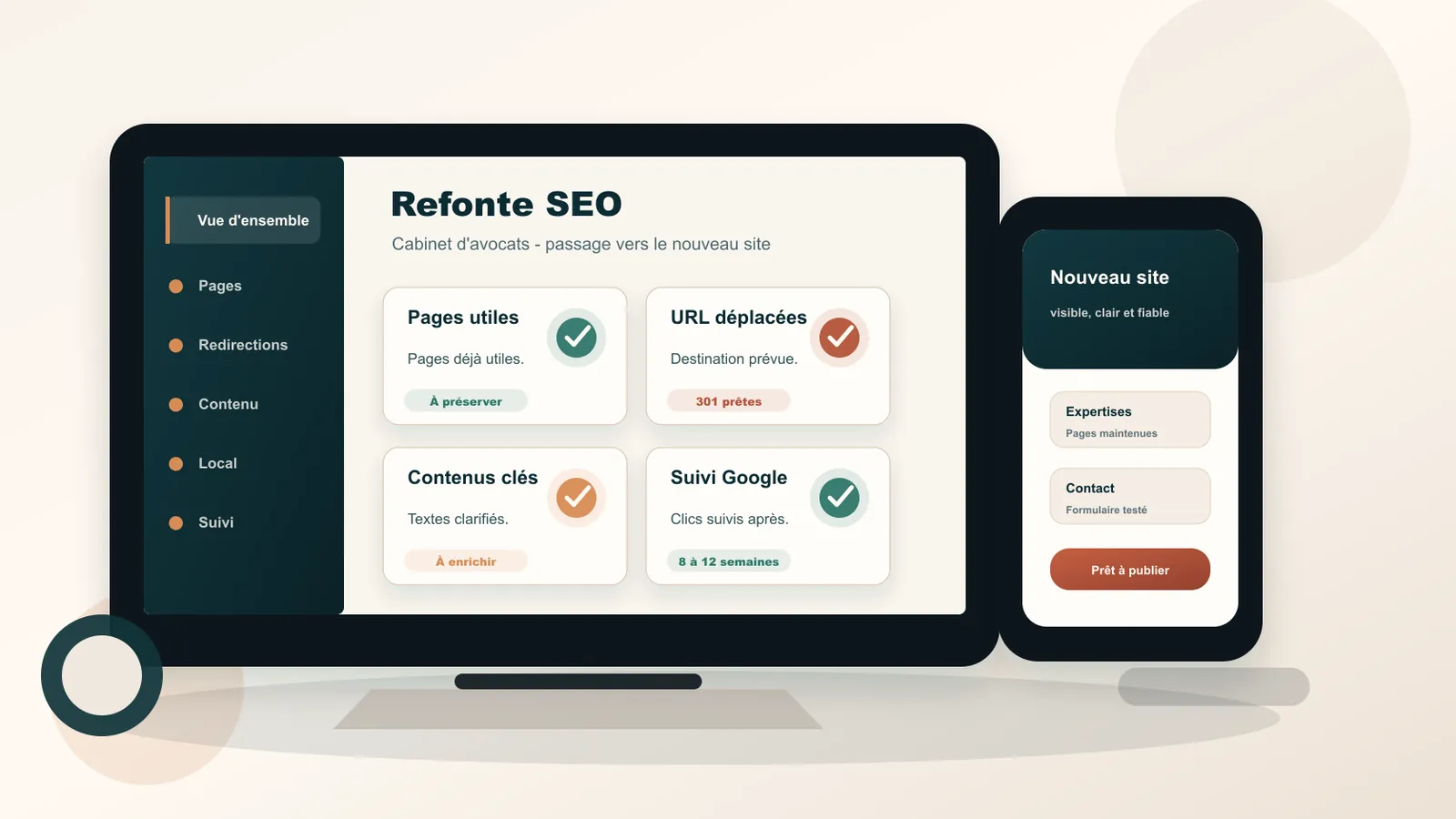
How much does a law firm website redesign cost?
Content, existing URLs, SEO and migration: what to examine when pricing a law firm website redesign and comparing quotes.
Read the articleRedesigning a law firm website: without losing search rankings
A redesign can improve a law firm's credibility, but a poorly planned one can lose Google rankings. Here are the points to safeguard.
Read the article