Redesigning a law firm website: without losing search rankings
A redesign can improve a law firm's credibility, but a poorly planned one can lose Google rankings. Here are the points to safeguard.
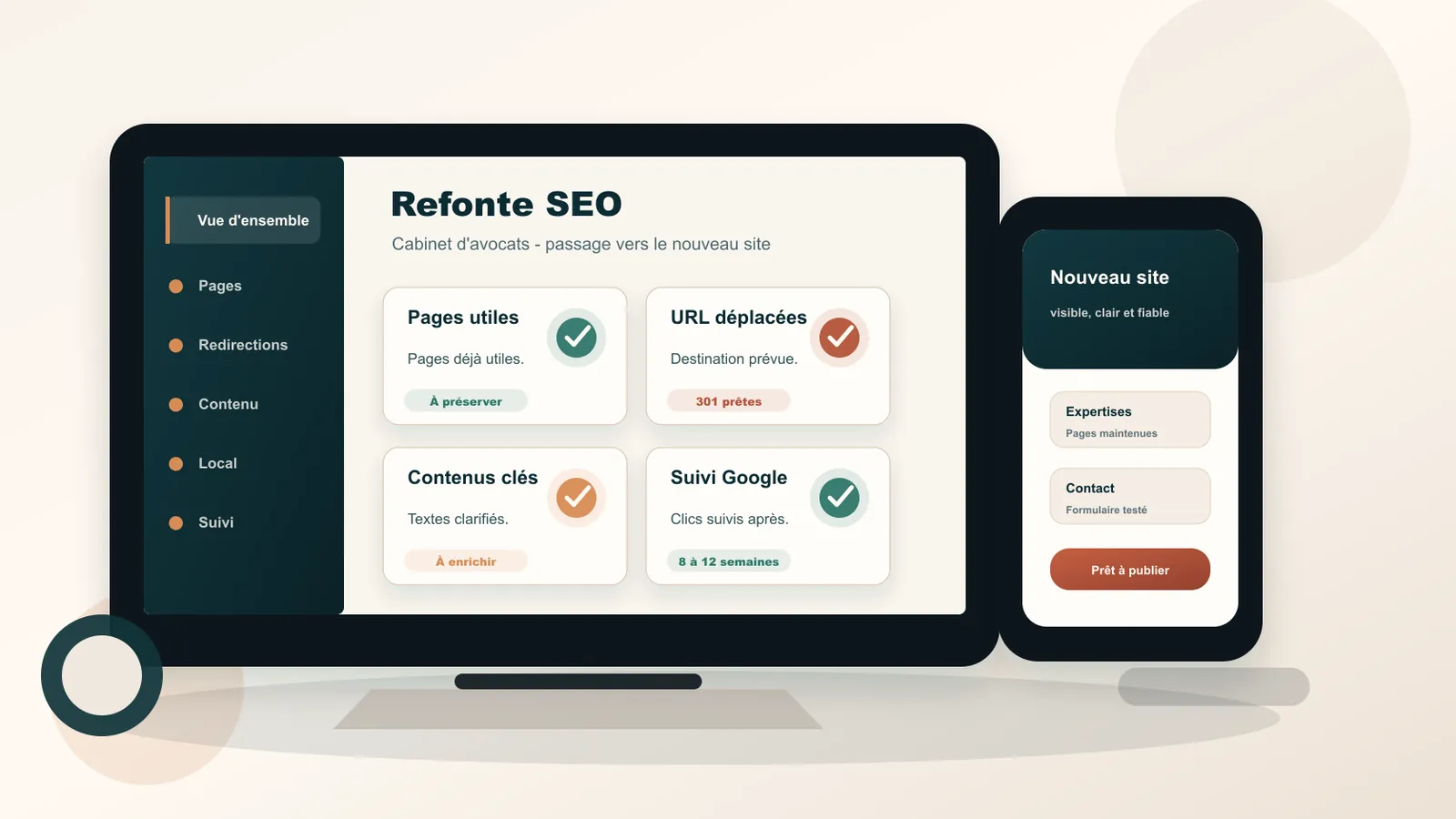
Making a new law firm's website can be an excellent decision: clearer message, more credible design, more structured pages of expertise, more visible contact. But a redesign can also reverse the SEO if it is treated as a simple model change.
The main risk is to delete, move or weaken what was already sending useful signals to Google: indexed pages, content that responded to searches, old URLs, links between pages, consistent Google Business Profile and existing contact requests.
For a firm, a redesign of law firm's website without losing useful pages must therefore start with the existing one. Before deciding what to do again, you need to know what is already working, what is blocking and what should not be broken.
Why a redesign can lose SEO
A redesign often changes several things at once: text, headings, URLs, menus, practice-area pages, forms, images, mobile speed and sometimes the CMS itself. Each change may help, but the overall scope needs to be planned.
Losses occur especially when useful pages disappear without redirection, when content is shortened to excess, when old URLs change without method, or when the new site appears more modern but less responsive to actual searches.
The article on the law firm website redesign mistakes details these traps. Here, the goal is to focus on the SEO part: how to do it again without starting from scratch.
Key takeaway
A good redesign protects the pages, URLs, content and signals that already help people find the firm.
Step 1: Inventory the pages visible on Google
Before reproducing the site, you must draw up a list of existing pages: home, contact, pages of expertise, articles, local pages, old news, important mentions. Next, a distinction must be made between pages that have a net value and those that can be deleted or merged.
The priority is to identify pages that receive impressions, clicks or requests. Google Search Console can help see queries, landing pages, average positions and already visible content.
Do not rely on visual impressions alone. An old, unattractive page may still attract useful searches. Removing it because it looks dated can lose a signal the new website will have to rebuild.
Step 2: Decide what to keep, merge or delete
Not all pages deserve to be kept as they are. Some need improvement, others need to be merged, others need to be redirected. A page may have few visits but attract a highly qualified request.
The pages of expertise are often central to a firm. They must explain the subjects dealt with, the situations accompanied, the type of client concerned and the logical follow-up to make contact. The article on the indispensable pages of a law firm's website gives a useful basis for structuring this part.
Conversely, poor pages created solely to target keywords can weaken the firm's perception. A redesign is also an opportunity to clean up what does not serve the visitor, credibility, or visibility.
Step 3: Prepare redirections before uploading
If a URL changes, a redirect should be provided before the new site is published. It's a simple point in appearance, but it's often where a redesign loses SEO.
An old page deleted without redirection can become an error 404. A page replaced by a different URL may lose its history. An deleted category can cut important links between content.
The right reflex is to prepare a clear picture: old URL, new URL, planned action. Some pages are kept, others are redirected to a nearby page, others are deleted if they have no value. The decision must be voluntary, not submitted at the time of posting.
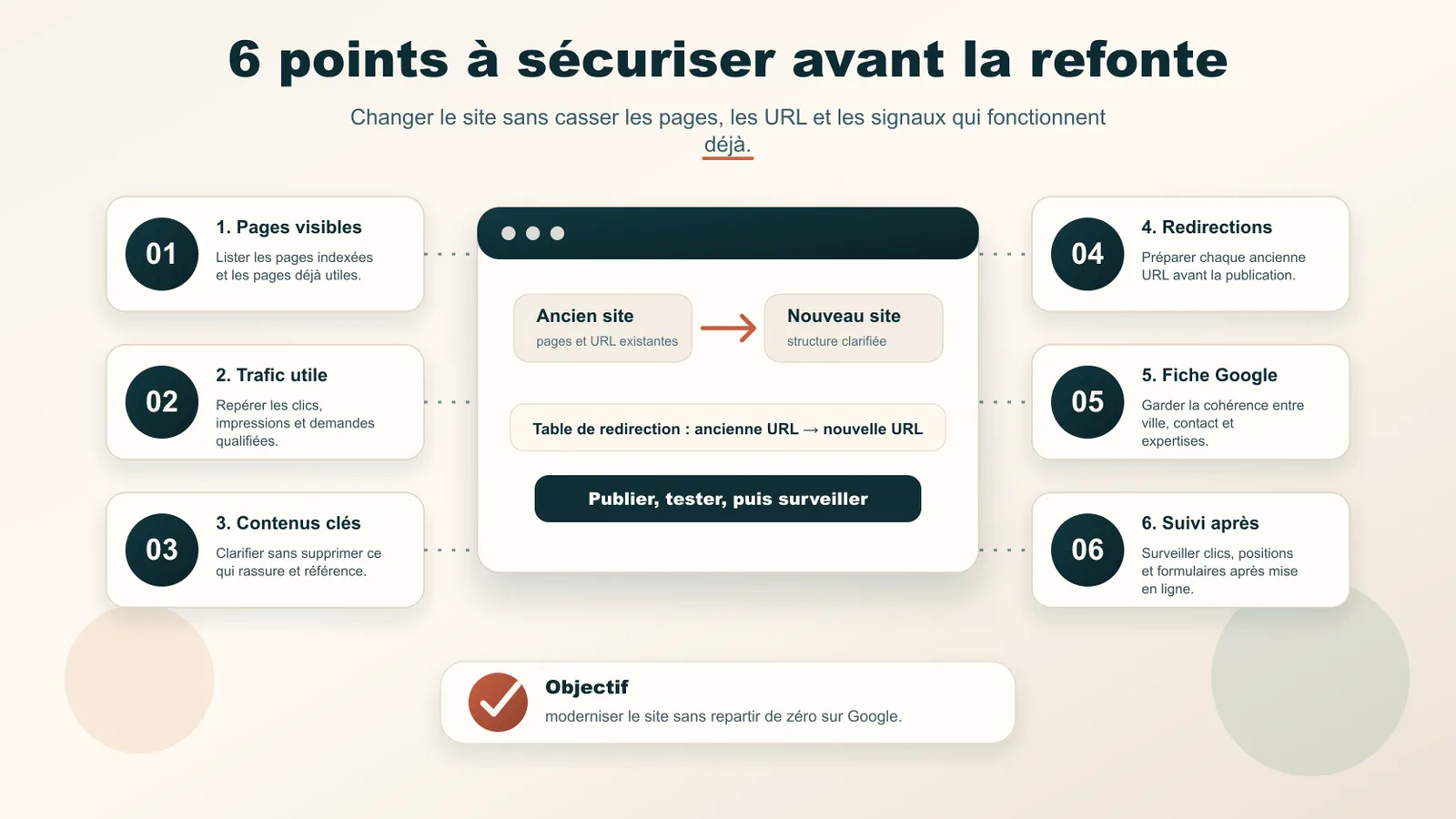
Step 4: Keep Content Reassuring
Searching a law firm's website depends on the keywords, but also on the page's ability to reassure: readable expertise, accurate information, clear contact page, firm identity, coherence of areas of intervention.
During a redesign, it is tempting to shorten texts to get a lighter site. Sometimes it's useful, but removing too much context can make pages less understandable to Google and less reassuring to a visitor.
It is therefore necessary to rewrite intelligently: clarify, prioritise, remove the blur, but keep the information that proves the firm's seriousness and the reality of its expertise.
Step 5: Link local SEO and Google Business Profile
For many firms, local SEO is essential. The city, address, intervention areas, pages of expertise and Google Business Profile must send consistent signals.
If the new site changes the contact page, local texts or areas of intervention, you must check the consistency with the Google Business Profile. The article on the local SEO for lawyers details this link between site, city, Google Business Profile and useful pages.
A redesign may be an opportunity to reinforce this coherence, but it can also break it if the city disappears, if the contact page becomes too vague or if the important expertise is no longer clearly linked.
Step 6: Monitor after publication
Online posting is not the end of the topic. After a redesign, it is necessary to check that important pages respond, that forms work, that redirects are active, that the sitemap is clean and that public pages are indexable.
SEO effects follow over several weeks. The delay depends on Google's re-exploration, the changes made and the traffic available to compare. During this period, we must monitor impressions, clicks, queries, landing pages and actual requests.
The maintenance of a law firm's website then becomes important: a new but unmaintained site can quickly lose credibility, reliability or performance.
Checklist before re-doing the site
Points to secure
Frequently asked questions
Can a law firm's website be redesigned without losing search visibility?+
A prepared redesign limits the risk: existing pages analyzed, important URLs retained or redirected, useful contents taken over, titles verified and follow-up Search Console after publication. Fluctuations remain possible; maintaining positions cannot be guaranteed.
Should we keep the old URLs during a redesign?+
You have to keep the URLs that work when possible. If a URL changes, a clean redirect must be provided prior to uploading to avoid losing the accumulated signal.
How long does it take to see the SEO effect of a redesign?+
The delay varies depending on the site, the volume of URL modified and their re-exploration by Google. It is necessary to follow indexing, impressions, clicks and requests over several weeks, then extend the observation if the volume remains too small.
Should we keep all the old contents of the firm?+
No. It is necessary to preserve or improve useful content, merge those that repeat and redirect deleted pages when they had value. Deleted without analysis can reverse the SEO.
Conclusion: Redo without starting from scratch
Redesigning a law firm's website while preserving SEO requires a clear method. Keep what already helps the firm, improve unclear content, redirect changed URLs and monitor the results after publication.
If your firm already has a site and you hesitate between maintenance, optimization or redesign, start with a clear reading of the existing one. Page law firm website redesign explains the planned support to take over a firm site without breaking what already works.
Read next.
How much does a law firm website redesign cost?
Content, existing URLs, SEO and migration: what to examine when pricing a law firm website redesign and comparing quotes.
Read the articleLaw firm website redesign: mistakes that cost clients
Confusing menus, weak practice area pages, hard-to-find forms and overlooked local SEO: mistakes to avoid when redesigning a law firm's website.
Read the articleLaw firm websites: essential pages that build trust
A law firm's website needs to build trust quickly. Essential pages that clarify practice areas, strengthen confidence and make contact easier.
Read the article