WordPress website audit: when is it really needed?
A WordPress website audit helps you determine whether your website needs maintenance, fixes or a redesign. Here is when it becomes useful.
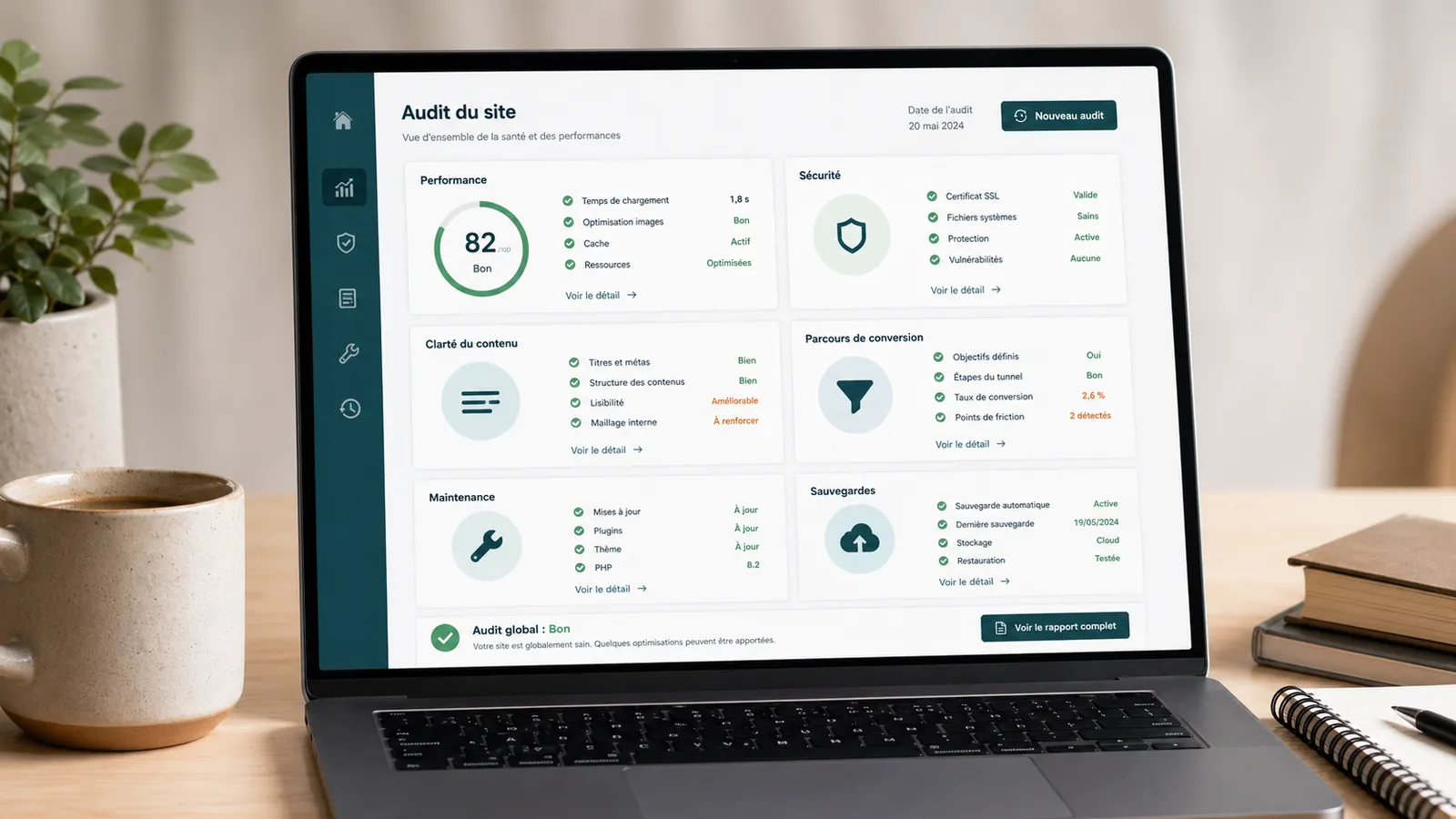
A WordPress site audit is not restricted to large companies. It becomes useful as soon as a site already exists, but its real state is unclear: slow site, painful administration, unknown plugins, uncertain backups, outdated content or difficult modifications.
Many small businesses have this kind of website. It still works, but nobody knows whether it is healthy, sustainable, secure or easy to take over. They can end up paying for the wrong work: maintenance on a fragile foundation, a redesign when targeted fixes would suffice, or optimisation while the message remains unclear.
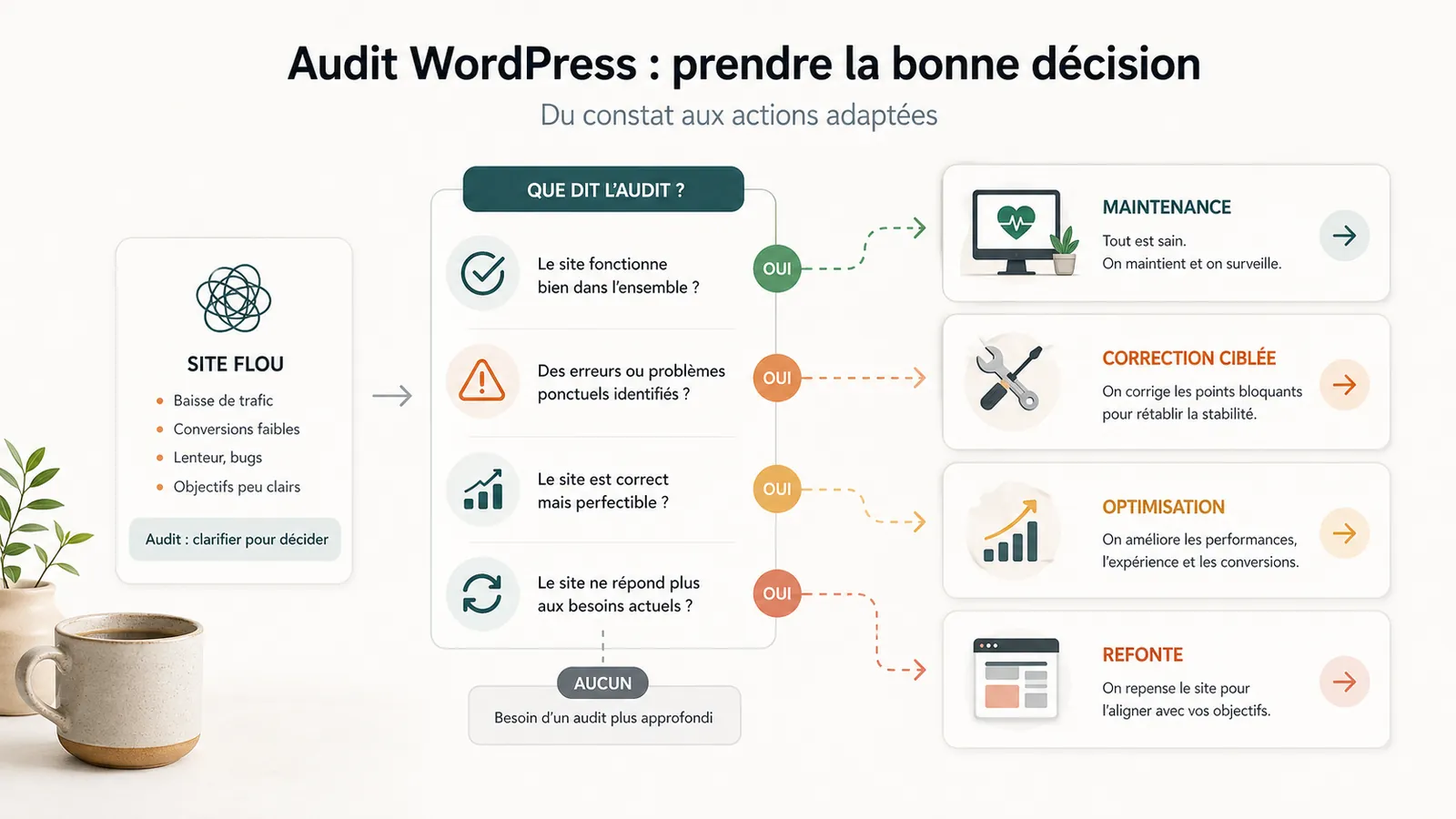
The purpose of a WordPress audit is to identify what to do now: maintain, fix, optimise, redesign or leave things as they are for the moment.
A WordPress audit first serves to make a good decision
An audit should answer a practical question: what is the next sensible decision for this website? It should not be a technical report written to impress.
An audit is not intended to complicate the decision. It is used to avoid paying for the wrong solution.
The no-obligation diagnostic review Often serves as a first reading. It allows us to see whether the subject is simple or whether it deserves a more complete analysis. Sometimes the answer is clear quickly: the site can go through maintenance. Sometimes you have to dig.
When an audit becomes useful
An audit becomes relevant when the problem is visible but its cause is not. For example: a slow WordPress site, heavy WordPress administration, pages that load badly on mobile, or a slow appearance after several successive additions.
It also becomes useful when the site has not been followed up: many unknown plugins, old theme, heavy page builder, updates not done for a long time, unclear backups, poorly identified access. In this case, we agree with the subject of the WordPress site not maintained: the site is not necessarily broken, but it becomes unpredictable.
Another signal: every small modification takes too long. Changing text, adding a page, replacing an image or adjusting a button should remain simple. If each request requires an understanding of how the site holds, the basis must be clarified.
When maintenance is probably enough
Maintenance is often enough if the site works globally, the main pages are still clear, the content remains consistent and no deep problems are visible.
In this case, the main need is follow-up: updates, backups, security, minor modifications, direct contact. One WordPress maintenance with a clear scope prevent the site from falling back into oblivion.
It's the role of an offer like the WordPress maintenance: the scope of the service Keep a healthy site under control. It is relevant when the base deserves to be preserved.
When a redesign becomes more rational than a long audit
Sometimes the problem goes beyond the technique. The site is slow, but also poorly structured. The message is confused, the important pages do not guide the visitor, the design ages, the offers have changed, the texts no longer correspond to the activity.
In this case, auditing too long can waste time. One Targeted redesign can be more rational than a series of small corrections on an outdated basis.
This does not mean everything should automatically be rebuilt. A diagnostic review or audit helps avoid automatic decisions, identifying what deserves to stay and what holds the website back.
What an audit needs to look at in practice
A good audit looks at the site as a set. Performance first: loading time, mobile, page weight, cache, images, scripts. The technique then: theme, plugin, versions, visible errors, quality of the base.
It must also look at security: updates, access, backups, certificate, forms. Then the content: important pages, message clarity, outdated information, consistency of offers. Finally, conversion: buttons, forms, user path, ease of contact.
The last point is often forgotten: sustainability. A site can be online and yet difficult to follow. If no one can change it properly, the problem will come back.
What an audit should not be
An audit should not be a 40-page incomprehensible report. Nor should it be a list of copied-paste automatic tools, or a pretext for selling a redesign.
A good audit must produce a clear decision and a list of priorities.
It must not promise a guaranteed SEO or commercial result. It must say where the site blocks, what is priority, what can wait and what option makes the most sense.
Examples of post-audit decisions
If the site is healthy but not followed up, the right decision can be monthly maintenance. If the site is slow but recoverable, a targeted correction or optimization may be sufficient.
If the website is technically fragile, it may need cleanup and targeted repairs before maintenance starts. If its underlying content and structure are outdated, a broader redesign or optimisation becomes more sensible.
The audit helps to choose an intervention adapted to the state of the site.
diagnostic review without commitment or full audit: what difference?
Diagnostic review without commitment is a first reading. It is used to understand the situation, identify obvious signals and direct the follow-up. It may conclude that a full audit is not necessary.
A full auditsite audit is more thorough. It becomes useful when it is necessary to analyze precisely causes, prioritize corrections and decide between maintenance, optimization or redesign.
Key takeaway
A WordPress audit becomes useful when the site still works, but the decision is unclear: maintain, correct, optimize or redo. It must help you choose the next action.
Frequently asked questions
How much does a WordPress site audit cost?+
The price depends on the depth of the analysis. An initial diagnostic review may be sufficient to guide the decision. A complete audit becomes useful if the site is slow, unstable, difficult to modify or technically unclear.
What is the difference between WordPress audit and WordPress maintenance?+
The audit is used to understand the state of the site and to decide what to do. Maintenance is used to track a site over time: updates, backups, security and minor modifications.
Should we do an audit before a redesign?+
Yes, if the doubt relates to the actual state of the site or what can be retained. In some cases, a diagnostic review is sufficient to show that a targeted redesign is more rational than a lengthy correction.
Conclusion: Clarify before acting
Not every WordPress website needs an audit. It helps when you no longer know whether the website needs maintenance, fixes, optimisation or a redesign.
If your site still works but its real state is unclear, start with a no-obligation diagnostic review. You will know if maintenance is sufficient or if a more complete audit is required.
Read next.

The beginnings of 2Cafés
Andrei Chirtes and Anthony Grasso met while studying Networks and Telecommunications. Here is how their shared ideas led to 2Cafés.
Read the article
Email campaign platform or custom-built tool?
Brevo, Mailchimp, a French platform or custom development: practical criteria for choosing without paying for unnecessary complexity or blocking your process.
Read the article
Case study: an email campaign to 33,100 contacts
How a custom email tool helped prepare, test and run a campaign to 33,100 contacts over 18 days, with precise acceptance and rejection tracking.
Read the article