Law firm website maintenance: what a firm really needs to monitor
Security, backups, forms, updates and key pages: what to monitor when maintaining a law firm's website.

People often visit a law firm's website before making contact. They want reliable information, clear expertise, an address, a way to contact the firm and an initial sign of professionalism.
In this context, maintenance is used to keep the site available, credible, secure, readable on mobile and simple to correct when information changes.
For a law firm, maintenance also protects the firm's credibility at a time when a prospect is already seeking to reassure itself.
A law firm's website must be credible before it is spectacular
A firm does not need a site overloaded with effects. It needs a sober, clear, available and up-to-date site. Credibility often comes from simple details: clean pages, accurate information, reliable form, correct loading, indications in place.
A visible error quickly sends the wrong signal. A broken button, slow page, old news item or outdated lawyer profile can suggest that the website is no longer maintained.
The page dedicated to the law firm website maintenance presents the service side offer. Here, the aim is to detail what a firm really needs to monitor.
If the problem exceeds the current tracking and touches the Google structure, message or visibility, the page law firm website redesign details the approach adapted to the firm.
Point 1: information about the firm
The basic information must remain accurate: address, telephone, email, schedule, team, associates, collaborators, areas of intervention and legal mentions.
Pages can become outdated without anyone flagging them. A lawyer who has left the firm, an area of expertise no longer promoted, an old news item or an outdated address can create doubt.
For a firm, outdated content sends a weak tracking signal.
Item 2: the contact form
The form is often more critical than it looks. It must work, send the messages to the correct email, display a clear confirmation and remain usable on mobile.
It is also necessary to monitor the antispam and the confidentiality of the information transmitted. A broken form may remain invisible for a long time: the visitor believes he has sent a request, but the firm receives nothing.
Maintenance must therefore include simple checks. A site that appears online but whose form does not work no longer fulfils its role.
Item 3: Security and access
A law firm's website must be followed properly: admin accounts, passwords, old service provider, plugin, updates, HTTPS certificate, exposed forms, unnecessary access.
We must not promise perfect security. On the other hand, leaving a site unmaintained increases the blind spots. One hacked WordPress website can redirect some visitors, send spam or be blocked by the hosting provider.
It is also the classic risk of WordPress site not maintained Everything seems to work until you have to act quickly.
Item 4: backups
A backup must be identifiable, complete and restorable. A firm's website contains important pages, evidence of credibility and sometimes forms. It must be recoverable after an incident.
There must be a backup somewhere is not enough. The article on the WordPress backup not found explains why this blurring can turn a simple incident into a heavy problem.
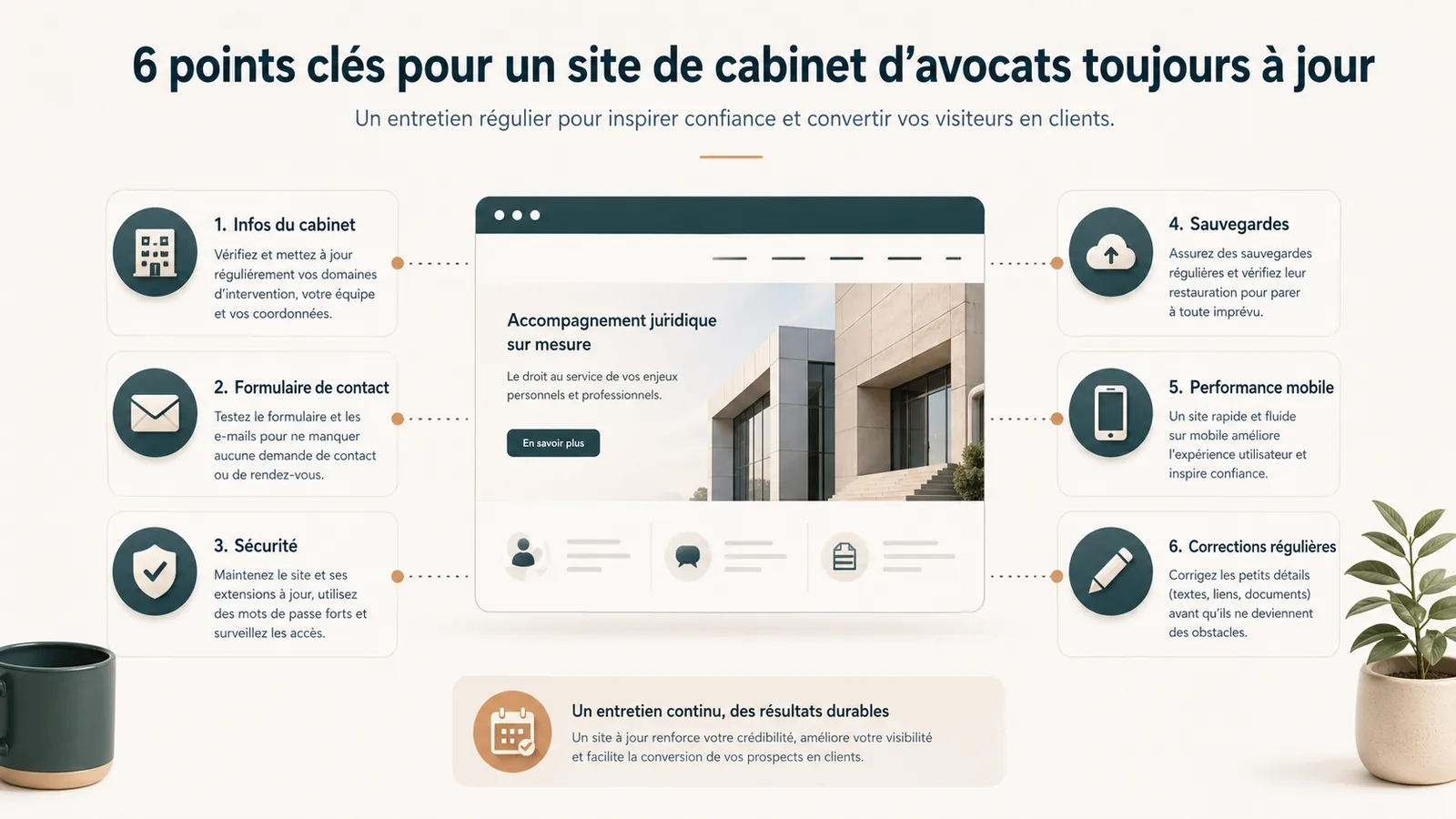
Item 5: Performance and mobile
Many visitors visit a lawyer's site from a phone. A quick search, a link sent by message, a Google Business Profile, and then a contact page. If the site is slow, the doubt comes before contact.
We must test the really important pages: home, contact, areas of intervention, law firm pages. If the site is slow, a site audit can help to understand if the problem comes from images, theme, plugins, hosting or structure.
Item 6: Small regular corrections
Maintenance also prevents small changes from being left pending: updating a partner's details or area of expertise, removing outdated news, correcting a button, replacing a photo, adding a notice or adjusting a page.
Even a small correction becomes awkward when it stays on hold. For a firm, visible details matter.
Maintenance or audit: when to choose what?
Maintenance is enough if the site is generally healthy, the content is correct, the access details are clear and the main need is for follow-up: updates, backups, security, hosting and small corrections.
This is the typical case of an offer such as the WordPress maintenance: the scope of the service, if the scope is framed and the site remains a good base.
An audit becomes a priority if the site is slow, confused, difficult to modify, technically unclear, if the form is uncertain or if no one really knows what condition it is. In this case, start with a no-obligation diagnostic review, then eventually go through a audit.
Key takeaway
A well-maintained law firm's website must remain reliable, clear, available and credible when a prospect checks if it can trust you.
Frequently asked questions
Why does a law firm have to maintain its site?+
A law firm's website often provides the first indication of its professionalism. Maintenance keeps information current, forms working, backups available, access secure and the website technically reliable.
What does a law firm's website maintenance include?+
It can include WordPress updates, security, backups, hosting, minor corrections, form checks, access management and checks of important information about the firm.
When should a law firm's website be audited rather than maintained?+
An audit becomes useful if the site is slow, confused, difficult to modify, technically unclear, or if no one really knows what condition it is in. Maintenance comes next, once the base is clarified.
Conclusion: Maintain the firm's credibility
The maintenance of a law firm's website serves to keep a credible, available, secure and simple site to correct.
If your firm already has a site but its tracking is unclear, start with a no-obligation diagnostic review. You will know whether it is enough to maintain it properly or whether you must first audit a more fragile base.
Read next.
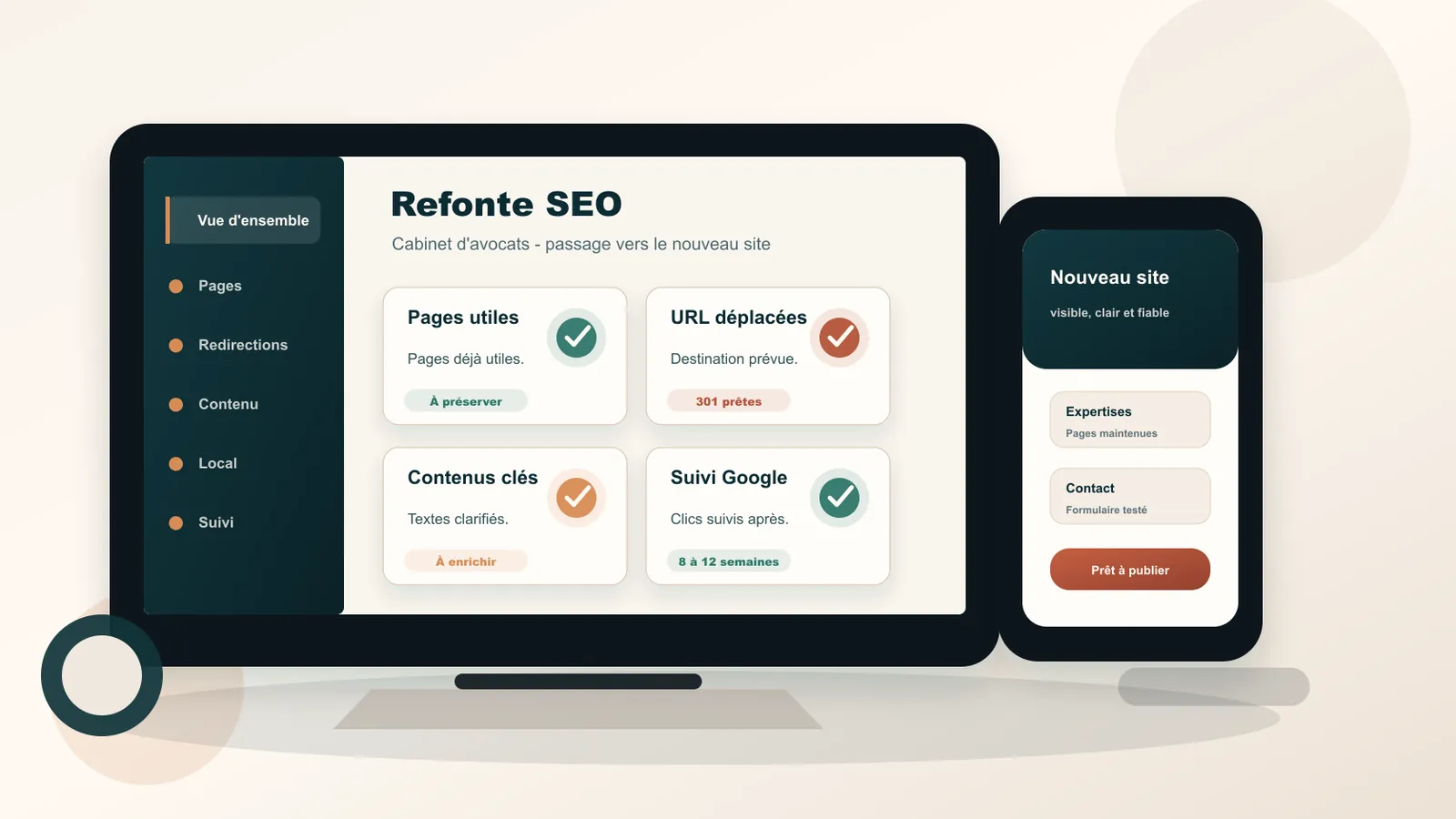
How much does a law firm website redesign cost?
Content, existing URLs, SEO and migration: what to examine when pricing a law firm website redesign and comparing quotes.
Read the articleRedesigning a law firm website: without losing search rankings
A redesign can improve a law firm's credibility, but a poorly planned one can lose Google rankings. Here are the points to safeguard.
Read the articleLaw firm website redesign: mistakes that cost clients
Confusing menus, weak practice area pages, hard-to-find forms and overlooked local SEO: mistakes to avoid when redesigning a law firm's website.
Read the article