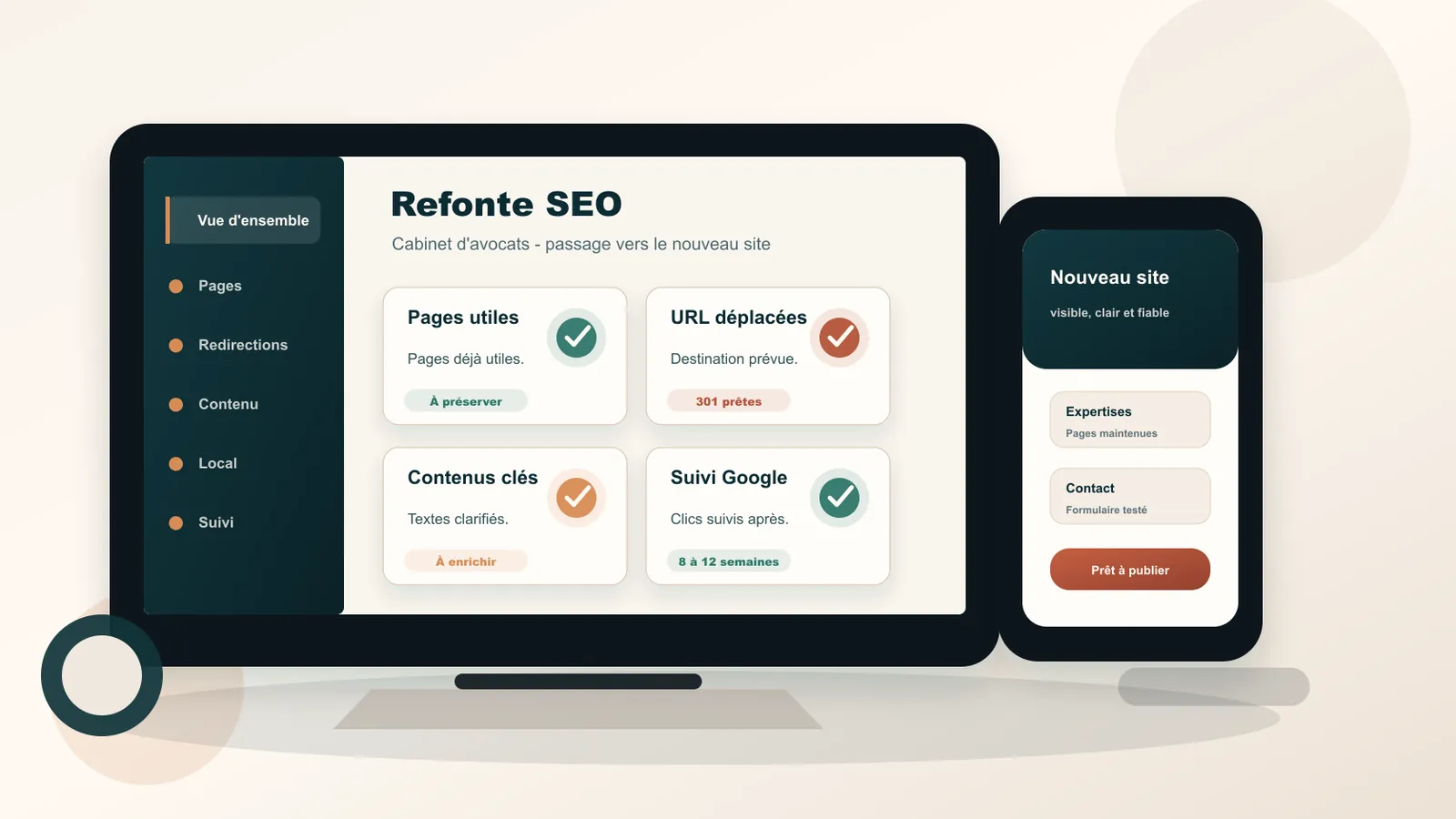
Redesigning a law firm website: without losing search rankings
A redesign can improve a law firm's credibility, but a poorly planned one can lose Google rankings. Here are the points to safeguard.
Read the articleWordPress law firm website
When building or redesigning a law firm's website, we organise the pages so visitors can quickly understand whether you handle their issue and how to contact you. For a redesign, we also identify the pages and URLs to preserve.
The signs
The website looks professional, but your practice areas are unclear: a visitor looking for an employment lawyer cannot tell whether you handle employment law.
Some pages appear on Google and no one knows whether to keep them, merge them or redirect them. Doubt has been blocking the redesign for months.
The site depends on an old service provider, a theme purchased eight years ago or a page builder that no one dares to open.
The form exists, but a request can be lost without the firm seeing: no one has checked since the last change hosting provider.
The firm's Google Business Profile, website pages and professional information do not quite agree on the address, bar membership or practice areas.
What We Do
We work on the organisation of pages, design, SEO and reliability of the site. Legal texts, professional statements and ethical choices remain valid by the firm.
Indexed pages, visible queries in the Search Console, addresses that receive impressions, content that reassures, links from outside. One starts from measured facts, not from an impression on visual quality: a page that one finds ugly can be the page that brings calls.
Every existing page is kept, improved, merged, redirected or removed, with a documented reason. Redirects are prepared and tested before launch, rather than fixed after the first errors appear in Search Console.
One page for each important practice area, using the client's vocabulary rather than legal code terminology: 'dismissal' before 'termination of the employment contract'. Thin pages written to target a keyword are obvious and weaken the firm's image.
For a new website or complete redesign, we code two different versions of the homepage. The firm's lawyers can use both working versions on a computer and phone before choosing, comparing their appearance and navigation.
Clickable phone, address, short form, first appointment modalities: everything is located without searching, and the contact page says the same thing as the Google Business Profile. The form is tested at sending, then actually monitored, because a silent form never warns.
Indexing, redirection, site map, forms and key pages are followed within weeks of publication. These controls help identify forgotten titles, incorrect redirections or default forms.
In detail
A lawyer's site can stay online for years while becoming less useful: a dated message, too wide pages of expertise, a discreet form, slowness on the phone, low local visibility. Rarely a single cause. Most often, an accumulation: and that's why the question "do you have to do everything again?" has no answer until you have read the site.
A redesign may cause visibility to be lost if useful pages disappear, their addresses change without redirection, or important content is removed. Before we change the site, we take up the pages that are visible in Google and those that contribute to the contact when the data allow.
We check the deleted pages, the address changes, the indexing of the preproduction and the links of the firm's Google Business Profile. Article redesigning your law firm's website while preserving SEO details the preparation; errors of a law firm's website redesign present the checkpoints.
The inventory gives us a list of existing URLs, the data Search Console provides about them, and a basis for deciding. Five decisions cover most cases.
| Decision | When it is appropriate | What it involves technically |
|---|---|---|
| Keep | The page receives visits or requests, and its content still holds | Keep the address identical, take the title and the text as it is or almost as it is |
| Improving | The subject is good, the text is short, dated or poorly structured | Same address, rewritten and enriched content, internal links added to neighbouring materials |
| Merge | Three pages deal with the same issue and compete in Google | One page kept, the other two redirected to it, their contents included in it |
| Reiriger | The page no longer has reason to be but still receives visits or links | Permanent redirect to the nearest page by subject, never to default home |
| Remove | No visits, no incoming links, no reusable content | Leave an error 404 frank rather than burdening the site with more redirection |
The firm can reread this list before the switch. Each decision is documented and the corresponding redirections are prepared and verified.
Someone looking for a lawyer scans a website to answer three questions: does this firm handle my problem, can I trust it and how do I contact it? Pages should follow that order.
The details of this structure are given in our article on the essential pages of a lawyer's website.
The firm approves legal content, professional disclosures and communication choices before publication. We prepare the website's structure and implementation; questions concerning professional conduct are addressed with the firm and its qualified advisers.
These validations are provided for in the schedule. We do not publish sensitive content without the consent of the firm.
A lot of research combines a matter and a city. Answering this does not require creating one page per commune of the department: it is the reflex that makes sites filled with empty pages: but to make coherent three elements: the expert pages, the contact page and the Google Business Profile of the firm.
In concrete terms, the address, the exact name of the firm and the telephone number must be written the same everywhere, including in the legal directories where the firm is already registered. The Google Business Profile must point to a page that exists and speaks about the right subject. The timetables must be accurate. And if the firm has several offices, each has its own page with its own coordinates, not a block of addresses stacked at the bottom of the welcome. Our article on the local SEO for lawyers uses the point-by-point method.
Some firms arrive with a volume that changes the nature of the project. On the LexCase Immigration website, it was necessary to manage French, English and simplified Chinese, as well as a news section, while keeping a simple enough basis for the team to publish without calling anyone. This requires preparation for migration, correspondence of addresses from one language to another, and publication tools. This is being prepared at the beginning of the project, not at the time of the changeover.
The creation allows you to define the pages and functions useful to the firm from the start. The work then focuses on three points. The domain name first, chosen once and for all and registered on behalf of the firm: never to that of the service provider, it is the precaution that avoids the painful takeovers ten years later. The list of materials then, which determines the structure of the site and which it is better to stop before talking about design. Finally, the texts, which take the time they take: it is almost always they who decide the date of posting.
The rest follows the approach described on our homepage: two working design proposals, hosting in France and a direct contact. A new firm does not need twenty pages. Six well-made pages, a completed Google Business Profile and a working form are more useful than a full website published half-finished.
Redesign is not always the right first answer. Three situations come back, and they don't call for the same expense.
Maintenance enough when the site is still a good base and what is missing is a follow-up: updates, verified backups, small corrections, someone responding. This is the object of our law firm website maintenance, without commitment.
Audit is imposed when no one really knows the state of the site: speed, pages, security, SEO, technical history, access. One audit sets the record and sets priorities before spending more. It helps the firm to choose the scope of work.
The redesign becomes a sensible choice when the message, structure or technical setup holds the firm back. We start by listing what needs to stay. An old page may look weak while still attracting searches or enquiries. We keep, improve or redirect it rather than remove it automatically. Our article on choosing between maintenance, audit and redesign helps to decide before even writing to us, and the one on which makes the budget of a redesign vary explains the elements to be specified for a quote.
After launch, we check redirects, titles, indexing instructions, the sitemap and the form. Search Console monitoring then shows indexing and changes in search queries. We agree the scope and duration of this monitoring with the firm, without guaranteeing rankings or indexing times.
Method
Pages visible on Google and the queries they appear for, URLs receiving traffic, reusable content, mobile speed, form performance and access actually held by the firm. At the end of this stage, you know what already works, which often differs from what you expected.
Maintenance, targeted correction or complete redesign: the level of intervention is chosen on the actual state of the site, not on its age. The scope, the calendar and what remains to be done by the firm (legal texts, validations, photos) are written before you start.
We organise the website around practice areas, trust and contact: which page serves which visitor, and how the homepage, practice areas, team and fees link together. Existing content is reused and rewritten where it remains useful.
Two design directions coded when the project justifies it, then integration of the chosen direction. Sobriety assumed: a firm site rarely gets to look like a communication agency. Readability on the phone is treated from the beginning, not caught up at the end.
Redirections tested one by one, titles and internal links included, site map sent, form verified from an external address. Then a follow-up in the Search Console: indexing new pages, errors, evolution of queries that already counted.
In practice
Law firm
WordPress site of a business law firm present in Paris, Lyon, Marseille and Bordeaux: expertise, teams, news and contact points.
Read the case studyLaw firm
WordPress site presenting the firm, its six poles of expertise, its team, its offers and its contents, simple to make evolve.
Read the case studyImmigration law
WordPress site in French, English and Chinese simplified, with a base of nearly 500 public articles and technical follow-up in the long term.
Read the case studyLawyer's practice in Lyon
An existing website audited and reworked for SEO: refocused key pages, a cleaned-up sitemap and more direct paths to contact.
Read the case studyLegal training
WordPress portal of legal, economic and financial training, available by domain, by city and by session.
Read the case studyFrequently asked questions
Yes, if useful pages disappear without a plan. That is why we start with an inventory: keeping URLs where possible, preparing redirects, preserving titles and internal links, and checking after launch. We reduce avoidable mistakes without promising rankings.
Maintenance is enough if the website remains healthy and easy to read. A redesign helps when the message, structure, design or contact process no longer serves the firm. We make that assessment after reviewing the website.
This depends mainly on the content. A targeted resumption on a site whose texts are already clear is proceeding fast. A complete redesign, with pages of expertise to be rewritten and validated by several lawyers in the firm, takes longer. The schedule takes into account content preparation, development and internal validations.
No. We handle the structure, technical work and readability. The firm approves legal content, professional disclosures and decisions concerning professional conduct with its qualified advisers before publication.
We can organise, clarify and format the content, and propose an outline for each practice area. The substance, sensitive wording and professional disclosures are written or approved by the firm before publication.
Yes, if it is well built, maintained and limited to useful plugins. The problems come mainly from a theme, from plugin, from backups and access that no one follows anymore. A firm site needs neither a heavy page builder, nor a marketing stack.
For the main practice areas, yes, provided each page answers a real question. A thin page created for a keyword does more harm than good. Six strong pages are better than twenty repetitive pages competing for the same searches.
Send us your current website URL, or describe your firm if it does not have a website yet. We review the pages, search visibility and contact process, then suggest the appropriate next steps, including when there is no urgent need for a redesign.
Explore further
On the blog
A redesign can improve a law firm's credibility, but a poorly planned one can lose Google rankings. Here are the points to safeguard.
Read the articleA law firm's website needs to build trust quickly. Essential pages that clarify practice areas, strengthen confidence and make contact easier.
Read the articleLocal SEO for a law firm relies on a clear structure, useful pages, consistent Google Business Profile information and a technically reliable website.
Read the article